
If your ad costs keep creeping up while most of your customers buy once and then disappear, you're not imagining it, and it's the exact problem lifecycle marketing is designed to solve.
Lifecycle marketing is sending the right message to each customer based on where they are in their relationship with your business, from the moment they first find you to the moment they're ready to buy again. Instead of sending everyone the same email at the same time, you plan your messages around the stages people move through, so a first-time customer hears something different from a loyal regular, and someone who has gone quiet hears from you before they're gone for good.
In this guide I'll walk you through what lifecycle marketing means for a small business, how it works for both product and service businesses, the five stages every customer moves through, the emails that belong at each one, and the order I'd set them up in if you're starting from scratch.
Lifecycle marketing in plain English
Think about a boutique skincare store where the person behind the counter treats a first-time visitor a little differently from a regular. The newcomer is asked about their skin and what they're hoping to fix, then shown a couple of products that suit them, while the regular is greeted by name, asked how they're finding the serum they bought last time and told about the new arrival they'll probably love. If that regular hasn't been in for a few months, the staff notice, and they make a point of checking in when they next see them.
Lifecycle marketing is that same thoughtfulness, built into your marketing so it happens for every customer without you having to remember each one. It isn't a new channel or another piece of software you need to buy, it's a way of planning the messages you already send so that each one fits where that person is right now.
Most of it happens through email, with SMS alongside where it makes sense, which is why you'll often hear it called lifecycle email marketing. The emails are set up once as automations, so they're sent at the right moment based on what each customer does, whether that's joining your list, making a first purchase or going a while without coming back.
Why lifecycle marketing matters for small businesses
Most small businesses put nearly all of their energy into finding new customers, through ads, social media and promotions, and then go silent once that first sale has happened. The trouble is that finding new customers keeps getting more expensive, and a business that relies on a steady stream of first-time buyers has to keep paying for every single one.
The people who have already bought from you or joined your list are the easiest people to sell to again, because they already know you, they've already trusted you once, and you already have their email address. Lifecycle marketing makes sure those people don't get forgotten, so more of them come back and buy again.
It also gives you time back. When the right messages are set up to go out automatically, you're no longer trying to remember who bought last week and who has slowly stopped coming back, which matters a lot when you're already wearing all the hats in your business.
The idea is the same for every business, but it plays out a little differently depending on whether you sell products or services.
How lifecycle marketing works for product businesses
If you sell products online, such as skincare, supplements or homewares, your customer's lifecycle is shaped by how long your products last and how often people naturally need more. A cleanser that runs out every eight weeks gives you a clear moment to remind someone to reorder, while a one-off purchase like a candle set is more about introducing them to what else they might love.
The biggest opportunity for most product businesses is the gap between the first order and the second. Plenty of customers buy once, enjoy the product and then simply forget about you, so lifecycle marketing focuses on teaching them how to get the most out of what they bought, reminding them when it's time to restock and making them feel looked after enough to come back.
How lifecycle marketing works for service businesses
If you sell services, such as studio memberships, clinic treatments, wellness sessions or stays at your accommodation, your customer's lifecycle is shaped by bookings rather than orders. The key moments are the first booking, the experience of that first visit, the decision to come back or commit to a membership or package, and the point where a regular starts to drift.
Service businesses also tend to have more personal touchpoints, like enquiries, consultations and conversations at the front desk, so lifecycle marketing works best when automation handles the reminders and check-ins and you save your own time for the conversations that matter most.
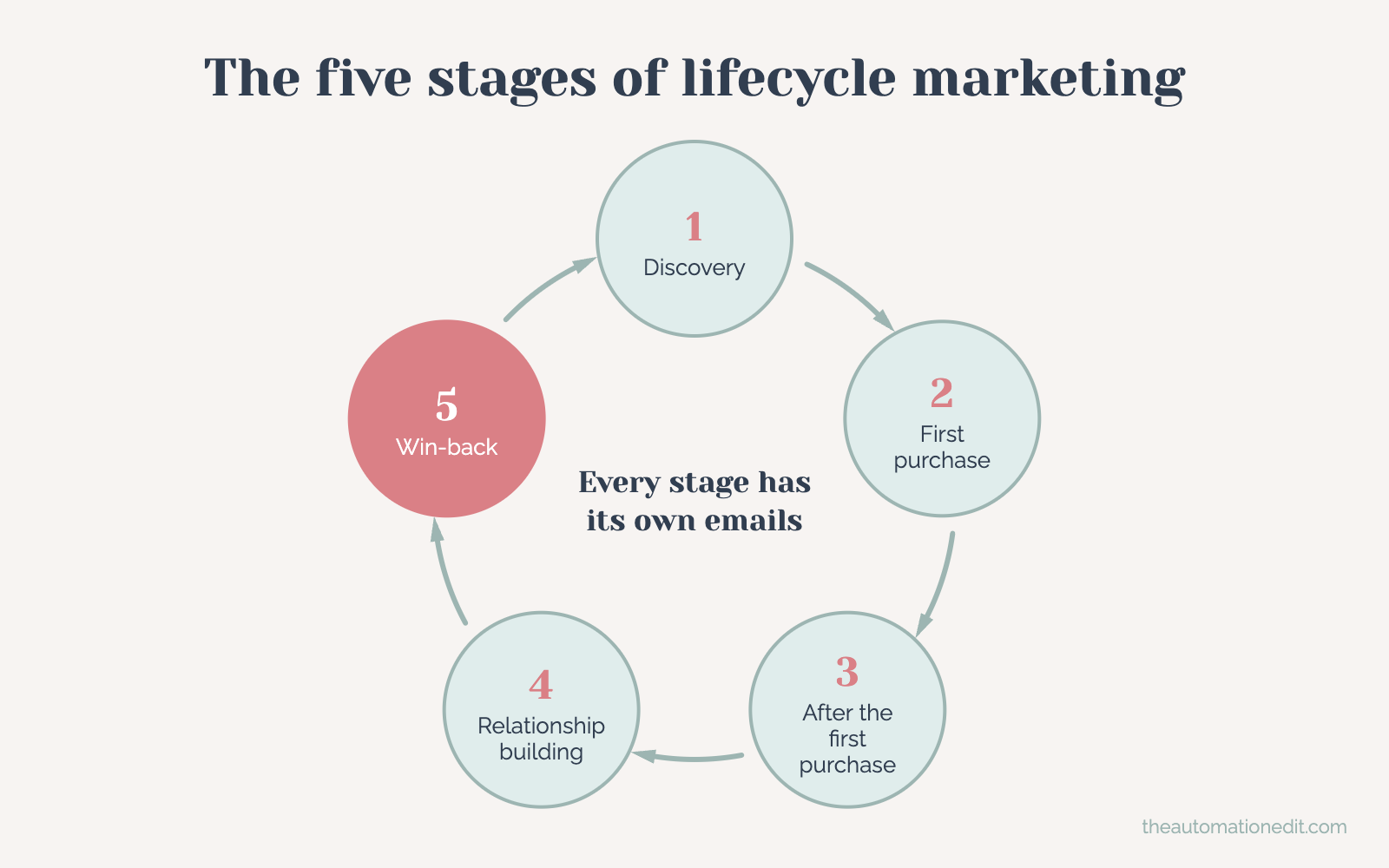
The five stages of the customer lifecycle
Every customer moves through roughly the same five stages, whatever you sell. Here's what each stage looks like, what your customer is thinking and what your marketing needs to do.
1. Discovery
This is the moment someone first finds you, usually by joining your email list through a popup on your website, following you on social media or making an enquiry. They're curious, but they don't know you yet, so your job is to introduce who you are, what you do and why you're different.
This is also the best moment to learn something about them. Asking one simple question when they join your list, such as what they're shopping for or what they're hoping to solve, means every email that follows can feel like it was written for them.
2. First purchase
Now they're interested enough to take a step, and your marketing needs to make that step feel easy. This is where reminders come in, for someone who looked at a product, added it to their cart or started checking out but didn't finish.
It's also where your welcome offer earns its keep. That offer doesn't have to be a discount, and a free gift or a sample-sized product with a first order can cost you less, protect your premium brand image and avoid teaching customers to wait for a sale before they buy.
3. After the first purchase
This is the stage most small businesses skip, and it's where a lot of repeat revenue slips away without anyone noticing. Once someone has bought for the first time, they need a reason to come back, and silence after the sale gives them every reason to try somebody else next time.
The goal here is to thank them, help them get the most out of what they bought and keep the relationship warm, so that when they're ready to buy again, you're the first business they think of.
4. Loyalty
Your regulars are your most valuable customers, and they deserve to feel like it. This stage is about rewarding the people who keep coming back, asking happy customers for reviews and referrals, and inviting them to commit to something bigger when the timing is right.
Loyalty doesn't have to mean a full loyalty programme with points and tiers. It can be as simple as building a segment that identifies your top customers, then giving them early access to new launches or a little gift with their next purchase, because surprise and delight goes a long way, and the real aim is making sure they feel seen and valued.
5. Win-back
Nobody tells you they're about to stop buying, they just stop. Win-back is about noticing when someone has gone quiet and reaching out before they're gone for good, with a warm "we haven't seen you in a while" message rather than a desperate discount.
The right timing depends on how often your customers would normally come back. If they usually reorder every couple of months, three months of silence is a good moment to check in, whereas for a regular who used to visit every week, a fortnight away might be enough.
The emails that belong at each stage
Once you can see the stages, it becomes much clearer which emails your business actually needs. This is how I map them out for my clients.
| Stage | Emails to set up | What they do |
|---|---|---|
| Discovery | Welcome series | Introduce your business, share your story and deliver the welcome offer you promised |
| First purchase | Browse, cart and checkout reminders | Bring back people who showed interest but didn't finish |
| After the first purchase | Post-purchase series, how-to-use tips, replenish or rebook reminders | Thank, educate and give people a reason to come back |
| Loyalty | VIP segment, review requests, referral asks, membership or package invitations | Reward regulars and turn happy customers into advocates |
| Win-back | Win-back series | Reach lapsed customers before they go cold |
You don't need all of these at once, and each one works best when it's kept simple and single-minded, with one clear message per email. You can always build on them later once the basics are working.
There are also two moments I never fully automate for my clients, which are the personal follow-up with a brand new lead and the conversation that turns a first-time customer into a long-term one, such as a member or a regular client. Everything around those moments can be automated, but those two land so much better when they come from a real person.

Lifecycle marketing examples
Here's how lifecycle marketing can look for a few different kinds of small business. The stages are the same in every example, it's only the details that change.
A boutique skincare brand
A new visitor lands on the website from an Instagram ad, and the popup asks them one question, which is their main skin concern, before inviting them to join the list for a free sample-sized product with their first order. They choose "dryness", so their welcome series is tailored to that, introducing the founder's story and then recommending the products that suit dry skin best.
When they add a hydrating serum to their cart but don't check out, a reminder brings them back to finish the order. Once the serum has arrived, a post-purchase email thanks them and shares a short guide on how to layer it, and around the time it's likely to run out, a replenishment reminder nudges them to reorder. After a few orders they're added to a VIP segment and invited to shop a new launch before anyone else, and if they go three months without ordering, a win-back email reminds them of what they bought last time and shows them what's new.
A wellness studio with memberships
Someone enquires about an intro offer and books their first class. Instead of a standard booking confirmation, they get a welcome email explaining what to expect, what to bring and where to park, and the day after their class, a short check-in asks how they found it.
As they get towards the end of their intro offer, often around their fourth or fifth visit, they receive an email explaining the benefits of becoming a member, including a story from an existing member about why they made the switch, while the studio owner follows up personally with a quick call or message. Once they're a member, they're asked for a review after a few weeks, and if they suddenly stop booking for a fortnight, a friendly message checks in before they drift away.
A clinic offering treatments
A new client books a first consultation, and their confirmation email answers the questions first-timers usually have, such as how long the appointment takes and how to prepare. After the treatment, an email shares aftercare tips and explains when they'll be due for their next appointment, followed by a rebooking reminder at the right time for that treatment.
Clients who come back regularly are added to a segment of top clients, who are offered first access to new treatments or a small gift at their next visit. If a regular client misses their usual rebooking window by a few weeks, a personal-sounding check-in invites them back.
A boutique accommodation business
A guest books a stay, and a pre-arrival email a few days beforehand shares check-in details, local recommendations and anything that will make their stay easier. After they leave, a thank-you email asks for a review while the stay is still fresh in their mind.
A few months later, guests who rated their stay highly receive an email about the best time of year to come back, with a small perk for returning guests, such as late check-out. Past guests who haven't booked again in a year are invited back with a seasonal email showing what's new.
In every one of these examples, none of the emails needs the owner to remember to send it, because each one is triggered by what the customer does.
Lifecycle marketing vs email marketing vs CRM
These three terms get mixed up a lot, so here's the simplest way to think about them.
Email marketing is the channel, meaning the newsletters, promotions and automated emails you send. A CRM, or customer relationship management system, is where your customer information lives, such as who bought what, when they last purchased and what they've been sent, and for many small businesses that's built into their email platform or booking system.
Lifecycle marketing is the plan that sits on top of both, deciding who should hear what and when, based on where each customer is in their relationship with you. You need the channel and the data to make it work, but it's the plan that turns them into repeat customers.
How to get started with lifecycle marketing
If you're starting from scratch, this is the order I'd recommend for most small businesses.
Set up your welcome series. This is where every new subscriber first gets to know you, so introduce your business, share your story and deliver your welcome offer, and if you can, ask one question when they sign up so you can tailor the emails to what they need.
Set up your post-purchase emails. These catch customers right after their first purchase, which is when they're most engaged and also most likely to drift away, so thank them, help them get the most out of what they bought and give them a reason to come back.
Add your abandoned flows. Browse, cart and checkout reminders bring back people who showed interest but didn't finish, and for service businesses, the same idea applies to someone who started a booking or made an enquiry and then went quiet.
Set up your win-back series. Decide how long is too long for your customers to go without buying, then reach out warmly before they're gone for good.
Start looking after your loyal customers. Build a segment of your top customers and give them something to feel special about, such as early access or a little gift with their next purchase, because it doesn't have to be a full loyalty programme to make people feel seen and valued.
Check your numbers every month. Keep an eye on your repeat purchase rate, how long it takes customers to come back for a second time, how many regulars you're losing, and how much of your revenue comes from automated emails.
Frequently asked questions
What is an example of lifecycle marketing?
A simple example is a skincare brand sending a replenishment reminder around the time a customer's product is likely to run out, or a studio sending a check-in the day after someone's first class. In both cases the message is triggered by where the customer is, rather than sent to everyone at once.
Is lifecycle marketing the same as CRM?
Not quite, because a CRM is the system that stores your customer information, while lifecycle marketing is the strategy that uses that information to decide which message each customer gets and when. Most small businesses use both together.
What does a lifecycle marketing specialist do?
A lifecycle marketing specialist plans and builds the messages that move customers from their first interaction to repeat purchases and loyalty, usually through email and SMS automations. Larger companies often hire for the role in-house, while small businesses usually work with a consultant who sets everything up and shows them how to run it.
What's the difference between lifecycle marketing and growth marketing?
Growth marketing usually focuses on acquisition, which means bringing new customers in through ads, experiments and channels like social media. Lifecycle marketing focuses on retention, which means looking after the customers you already have so they buy again, stay longer and tell their friends. Most businesses need both, but many small businesses spend almost everything on acquisition and very little on retention, which is why lifecycle marketing is often where the quickest wins are hiding.
Do I need special software for lifecycle marketing?
Most email platforms can send automated emails, but the triggers and features are much more limited in some tools than others, which affects how personal and well-timed your emails can be. For product businesses I recommend Klaviyo, because it connects closely with your online store and it's very easy to use. For high-touch service businesses with a sales pipeline, such as consultations or enquiries that need following up, I recommend ActiveCampaign.
Ready to see what your business is missing?
If you'd like to find out which of these emails your business is missing and set them up yourself, my Email Revenue Roadmap™ gives you a personal review of your account and a clear idea of where to focus first, along with my signature email system training library to help you build each one.
If you'd rather have it all done for you, The Revenue Journey System is my 90-day marketing automation consulting service, where I find where your business is losing customers and build the emails that keep them, in your words and inside the platform you already use.
And if you're still deciding which would suit you best, send me a message through my contact page or email me at hello@theautomationedit.com, and I'll let you know which option I think would suit your business.
